Legacy System Modernization Without Rewriting: How to Extend Existing Systems Safely
/TABLE OF CONTENTS
/ARTICLE
/ARTICLE
[1]TL;DR
- Legacy is not about age. It's about whether you can change a system safely, and that's a coupling problem, not a language problem.
- Rewrites fail because they concentrate risk into a single cutover event, forcing the new system to rediscover everything the old one learned in production, all at once.
- Anti-Corruption Layer, Strangler Fig, and Branch by Abstraction distribute that risk safely: no cutover, no coupling leak, no callers broken mid-migration.
- All three patterns share one unsolved dependency: the integration boundary between old and new code. Left untyped, that boundary is exactly where coupling re-enters, and safety breaks down.
- Graftcode enforces that boundary at compile time. New services install a strongly typed Graft for the legacy system via a package manager, and GraftConfig switches between in-memory and remote via an environment variable, with no code change.
If you've already decided to modernize incrementally and want help choosing which pattern fits your specific situation, see Legacy Modernization Without Rewriting: Patterns, Strategies, and Smarter Migration.
Software systems become legacy gradually, through accumulated coupling, undocumented assumptions, and code paths nobody fully understands anymore. The system works, but changing it safely has become expensive enough that teams avoid it. Features get bolted on at the edges. The system grows harder to extend every quarter.
The instinct at that point is usually to rewrite. In practice, rewrites don't just take longer than expected; they concentrate an enormous amount of risk into a single moment, the cutover, where old and new systems have to coexist or hand off cleanly. When that boundary isn't managed carefully, the failure isn't gradual. It's total, and it happens in production.
This guide covers why that risk concentration makes rewrites dangerous, which incremental patterns distribute the risk safely instead, and, critically, how to keep the integration boundary between old and new code from becoming the place where all the coupling you were trying to escape quietly re-enters.
[2]What Makes a System Legacy
Legacy is not about age or language. A ten-year-old order processing service with clean module boundaries and well-defined interfaces isn't legacy. A two-year-old order processing service where order status logic, inventory checks, and payment retries are all threaded through the same handful of files with no clear ownership boundary already is.
The defining trait is that you can't change it safely. Not because the code is old, but because the coupling is dense enough that a change in one place produces unexpected effects elsewhere. Changing how payment retries are triggered can silently break how order status is reported, because nothing enforces that these are separate concerns. Tests don't catch it because they were written around the existing coupling rather than against stable contracts.
Three patterns tend to create this state:
- Tight domain coupling: logic spread across modules with no ownership boundaries, sharing models, state, or tables
- Implicit contracts: services depending on undocumented assumptions about each other's behavior or data shapes
- Accumulated integration code: HTTP clients, DTOs, and versioning hacks written ad hoc over time, forming a second system on top of the first
This is why a Java monolith with clean domain boundaries is easier to modernize than a year-old microservices system where every service calls every other through hand-written HTTP clients with no schema enforcement, deployment topology doesn't determine legacy status, coupling does. A rewrite that reproduces the same domain structure in a new language produces the same legacy system in a new coat.
[3]Why Full Rewrites Tend to Fail
Rewrites are appealing because they feel like a clean break: design it correctly this time, without the accumulated constraints. The track record is poor.
Knight Capital Group's 2012 failure is the canonical example of what goes wrong at the integration layer. A deployment error left old and new code running simultaneously, and the system executed unintended trades for 45 minutes before anyone could intervene, costing the company $440 million. The failure wasn't in the new logic; it was in assuming old and new systems could coexist without careful management of the boundary between them.
The underlying problem: a system's complexity doesn't live primarily in the code. It lives in the integration contracts between components and the behavioral edge cases the existing system has accumulated over years of production use. A rewrite has to rediscover all of that from scratch, under time pressure, and risk gets concentrated into a single cutover event, exactly the kind of moment where an unmanaged boundary between old and new code turns into a production incident instead of a contained failure.
[4]How to Extend a Legacy System Without Replacing It
The alternative is incremental modernization: extracting capabilities gradually, validating each extraction in production, and keeping the legacy system running throughout. Each of the following patterns is safe for a specific reason: no coordinated cutover, no coupling leaking into new code, no callers left broken mid-migration.
Anti-Corruption Layer
The Anti-Corruption Layer (ACL) sits at the boundary between a new service and the legacy system, translating between domain models. Hence, the new service never inherits the legacy system's field names, data shapes, or quirks.
class OrderACL:def from_legacy(self, legacy_order: dict) -> Order:return Order(id=legacy_order["order_id"],customer_id=legacy_order["cust_no"], # legacy uses "cust_no"total=Decimal(legacy_order["amt"]), # legacy stores as stringstatus=self._map_status(legacy_order["stat_cd"]))
Without the ACL, this failure looks like a new fulfillment service consuming the legacy order processor's data directly. Within a few sprints, its own domain model has quietly absorbed the legacy system's abbreviated field names and string-encoded amounts, because it was faster to pass the data through than translate it. Six months later, the fulfillment service exhibits the same technical debt as the order processor it was supposed to modernize away from; the coupling wasn't removed, it just moved into a new codebase. The ACL is what keeps this from happening: the new service is only ever safe from the legacy system's quirks if something at the boundary is actively translating them.
Strangler Fig
Strangler Fig migrates a system incrementally by routing traffic away from the legacy system one capability at a time:
- Put a routing layer in front of the legacy system
- Identify one capability with clear boundaries and low entanglement
- Build the new service for that capability
- Route traffic for that capability to the new service
- Validate under real traffic, then repeat
Applied to the order processor: step one puts a reverse proxy in front of it. Step two identifies invoice generation specifically, not order processing as a whole, because it has a clear input (an order) and a clear output (an invoice record), with minimal entanglement with inventory checks or payment retries, which stay on the legacy system for now. The new invoice service goes live behind the proxy, traffic for invoice generation routes to it, and the order processor keeps handling everything else exactly as before.
This is what makes the pattern safe: the legacy system stays live throughout. There's no cutover event and no point where the whole system is at risk simultaneously, the exact failure mode that made Knight Capital's rewrite catastrophic.
Branch by Abstraction
Branch by Abstraction handles changing something the legacy system actively depends on without breaking it mid-change: introduce an abstraction over the component, implement the new version behind it, migrate callers gradually, then remove the old implementation once every caller has moved. It's most useful inside the legacy system itself, replacing a database layer or a core algorithm without a full rewrite.
This shows up most often when the order processor's database access layer needs to change, moving from raw SQL scattered across the codebase to a repository pattern, say. Introducing the abstraction first means every caller inside the order processor keeps working unmodified while the new implementation is built and tested behind it. No caller is ever left calling something that's been removed mid-migration; that's what makes this pattern safe specifically for changes with many internal dependents.
What All Three Patterns Require
None of these patterns solve the integration boundary between the legacy system and the new services calling it. Every call still needs a communication mechanism, and that mechanism has its own coupling cost, which is where most incremental modernization efforts quietly stop being safe, even when the pattern choice itself was correct.
This is the gap all three patterns share: they tell you how to structure the extraction, but not how to keep the connection between what's extracted and what remains from recreating the coupling the extraction was meant to remove.
[5]Where Legacy Modernization Breaks Down in Practice
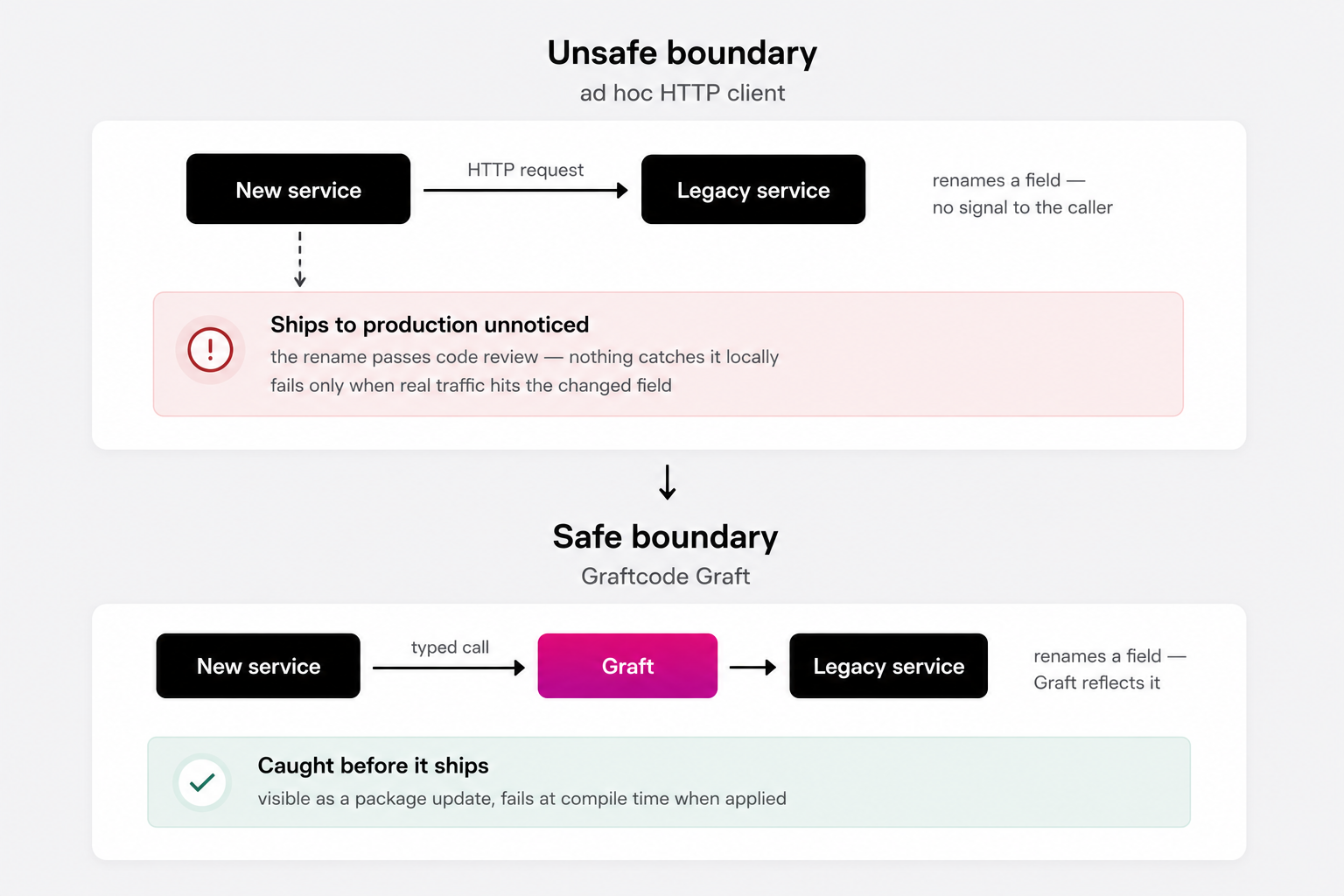
Every new service that needs to call the legacy system typically writes its own HTTP client, defines its own DTOs, and implements its own serialization and version handling. Each of these grows independently, with no shared contract enforcement.
When the legacy service renames customerId, this doesn't fail at compile time. A renamed response field raises a KeyError at runtime; a renamed request field is more likely to trigger a server-side validation error. Either way, there's no signal until it happens in production, the exact class of silent, unmanaged boundary failure that makes an integration layer unsafe.
# New Python service calling legacy Node.js order processordef get_order_status(order_id: str) -> dict:response = requests.get(f"http://legacy-order-service:3000/api/v1/orders/{order_id}",headers={"Authorization": f"Bearer {get_service_token()}"},timeout=5.0)data = response.json()# No compile-time warning if legacy service renames "customerId"return {"customer_id": data["customerId"], "status": data["orderStatus"]}
In a 15-service system where eight services call the legacy order processor, there are eight versions of this integration code. The integration surface grows quadratically; one new service calling two legacy services adds two integration paths; five services each calling three legacy services adds fifteen. The maintenance burden scales with the number of service pairs, not with team size, and every one of those paths is a place where coupling can re-enter without anyone noticing until it fails.
[6]How Graftcode Lets New Services Call Legacy Code as a Local Dependency
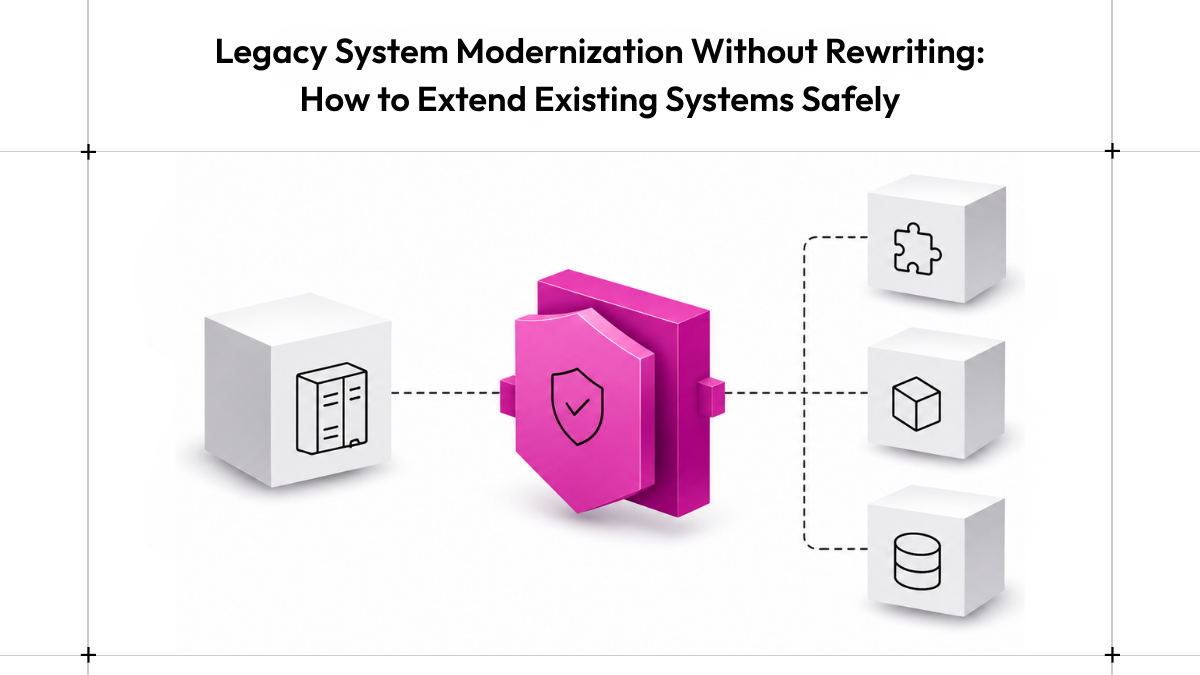
Strangler Fig, Branch by Abstraction, and the ACL tell you what to extract and how to structure it safely. None of them solve the cost of keeping the integration contract enforced while the migration is in progress, and that's the exact gap where Knight Capital's failure originated: old and new code coexisting without a properly managed boundary between them. Graftcode addresses that boundary directly.
A new service installs a strongly-typed Graft, generated from the legacy service's public methods, via its standard package manager. The call reads like a local method call.
The Graftcode Gateway is what runs the legacy service; it spins up a runtime for the configured modules and exposes their methods to callers, according to access policies the developer defines. It's not a separate sidecar sitting beside an independently-running service; gg is what hosts and executes the service itself. It doesn't route traffic between services or control whether calls run locally or remotely; that's GraftConfig's job, and it lives inside the calling service.
# Run the legacy service through the Gatewaygg --modules ./order_processor.py
Developers control exactly which assemblies, namespaces, classes, methods, files, or folders get exposed. Nothing is surfaced beyond what's explicitly configured; for a legacy codebase, this matters, since teams don't want the entire legacy service exposed by accident, only the specific capability being extracted or made available to new services.
The Gateway serves calls on port 80 and Graftcode Vision on port 81, by default. Vision is a live interface showing every method the legacy service has been configured to expose, derived from the running code itself.
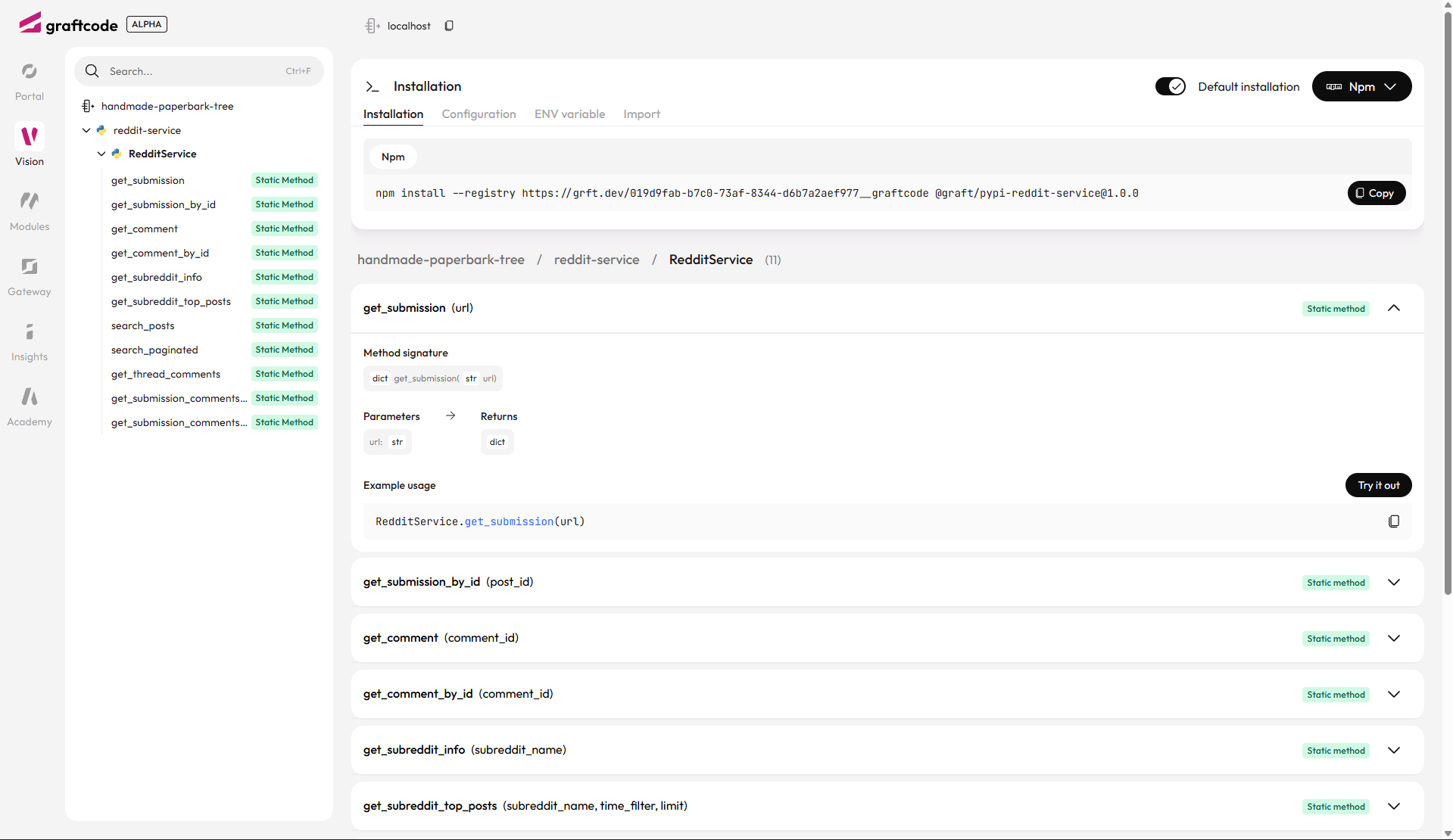
A new service installs the Graft using the command Vision generates, then calls the legacy logic directly:
# Before — hand-written HTTP clientdef get_order_status(order_id: str) -> dict:response = requests.get(f"http://legacy-order-service:3000/api/v1/orders/{order_id}", ...)data = response.json()return {"customer_id": data["customerId"], "status": data["orderStatus"]}# After — typed Graft callfrom graft_orderprocessor import OrderProcessor, GraftConfigGraftConfig.host = os.environ.get("ORDER_PROCESSOR_HOST", "inMemory")def get_order_status(order_id: str):return OrderProcessor.get_order(order_id=order_id)# If legacy service renames "customerId", this fails at compile time
The HTTP client, DTOs, serialization, and auth header construction are gone. What remains is the call, enforced at compile time in the calling service's native type system; the boundary is no longer a place where a silent rename can turn into a production incident.
GraftConfig is what makes this a migration mechanism, not just a syntax improvement. It controls whether the call runs in-memory or remotely, set via environment variable, config file, or a method on the Graft directly, with no code change:
GraftConfig.host = "inMemory" # local developmentGraftConfig.host = "tcp://legacy-order-service:9000" # staging/production
This maps directly onto Strangler Fig. During development, calls run in-memory. When ready to validate against the deployed legacy system, one environment variable change routes the call to its Gateway, with the same calling code on either side, no coordinated cutover, no moment where the calling service's code is in an ambiguous state between old and new.
When the legacy service changes a method signature, that change is visible immediately as a package update in the calling service. Teams update on their own schedule; incompatibilities surface at compile time when applied, not as a KeyError discovered in production.
The transport underneath is Hypertube, a binary runtime bridge connecting language runtimes directly rather than wrapping HTTP, no JSON serialization, no text protocol overhead. Graftcode runs roughly 70% faster than equivalent web service calls and consumes about one-eighth the CPU, which matters at infrastructure cost for high-throughput legacy calls, not just at the developer experience level.
[7]What an Incremental Modernization Path Looks Like
Applied end-to-end, the order processor migration looks like this.
Expose legacy modules through Graftcode Gateways before extracting anything. This creates live documentation via Vision and enforces the integration contract immediately; any new service calling the legacy system does so through a Graft, not an ad hoc client. Nothing about the legacy system's behavior changes at this stage.
Build new services against the Graft, not the legacy system directly. GraftConfig set to in-memory during development means new services can be built and tested independently of the legacy system's availability, while already calling it through the same typed contract that will apply once the connection goes live.
Extract capabilities with Strangler Fig. The calling service's GraftConfig target changes from the legacy Gateway to the new service's Gateway, same calling code, no redeploy of dependent services. Rolling back is the same operation in reverse: change the target back, no code deployment required.
Retire legacy modules as extraction completes. Vision's exposed interface shrinks as methods are removed, until the legacy system handles nothing a new service can't handle instead.
What "done" and safe look like: every cross-boundary call is a typed contract enforced at compile time, and no team discovers a breaking change by having their service fail in production.
[8]Conclusion: Legacy Modernization Is a Boundary Problem, Not a Language Problem
Legacy systems persist because the cost of modernizing them safely is high, not because teams lack motivation. Rewrites promise a clean break but concentrate risk into a single cutover and force the new system to rediscover everything the old one learned over years of production use, the exact conditions that turned Knight Capital's deployment into a $440 million failure.
The incremental path distributes that risk across time and keeps the system live throughout. The constraint is the integration boundary: every connection between old and new code is a point where coupling can re-enter if the contract isn't enforced. Graftcode addresses that constraint directly; the Gateway exposes legacy logic as a typed interface, new services call it as a local dependency, and GraftConfig switches between in-memory and remote with no code change.
To see how Graftcode fits your modernization path, explore Graftcode or go straight to the Graftcode Academy to get started with your first Graft.
[9]FAQs
1. What is the difference between legacy modernization and a legacy system migration?
Modernization improves an existing system's structure and extensibility without replacing it wholesale, and it stays incremental while the system runs throughout. Migration typically implies a cutover to a new platform. Most successful transitions use modernization techniques like the Strangler Fig pattern rather than a hard cutover.
2. When does the Strangler Fig pattern fail to work?
When the capability being extracted has too many entanglements to isolate cleanly, or if it shares a database with another module, extracting one without resolving that coupling first won't work. It also struggles when the legacy system has no clear domain boundaries to extract from in the first place.
3. How does Graftcode handle legacy systems written in a different language than the new services?
Graftcode supports 20 programming languages and 10 package managers. The Gateway exposes the legacy service's methods regardless of language, and the Graft is generated in the calling service's native language with full type safety, no cross-language integration code required.
4. How does GraftConfig support the Strangler Fig migration pattern specifically?
GraftConfig determines whether a Graft call runs in-memory or against a deployed service, set via environment variable or config, with no code change. When a capability is extracted, the GraftConfig target moves from the legacy Gateway to the new service's Gateway. If the extraction needs to be reversed, the same variable routes calls back.
5. Can Graftcode coexist with existing REST or gRPC interfaces on the legacy system?
Yes. Legacy services can keep exposing REST or gRPC for external consumers while running a Graftcode Gateway for internal calls. Adoption can start with a single new service calling a single legacy module through a Graft.
/WRITTEN BY