A Practical Guide to Protocol-Agnostic Microservice Integration
/TABLE OF CONTENTS
/ARTICLE
/ARTICLE
[1]TL;DR
- Microservice integration is the general problem of how services communicate; protocol-agnostic design is one specific technique for solving part of it, separating a service's interface from its transport, not a replacement for choosing the right pattern in the first place.
- No single pattern (REST, events, RPC, service mesh) fits every call in a system. The right choice depends on whether a call needs an immediate response, fan-out to many consumers, or uniform security across a large fleet of services.
- Regardless of the pattern, most systems couple the interface to the transport in the calling code, which is why the integration surface grows faster than the service count: three fully interconnected services require up to six integration paths; ten require up to ninety.
- Making the integration decision reversible means a service's interface stays stable regardless of which transport carries a given call; switching that transport should be a configuration change, not a rewrite of every caller.
- Graftcode does this through GraftConfig, which determines whether a Graft call runs in-process, over a direct connection, or via a broker-mediated plugin, while the calling code remains identical across all three.
Every microservices system eventually runs into the same question: how should two services actually communicate? The answer usually starts simple: pick REST, wire up the calls, move on, and then gets complicated as the system grows, workloads diverge, and the pattern that worked for the first five services stops fitting the next fifteen.
This guide covers the landscape of microservice integration patterns from the ground up: what integration actually requires at a technical level, the main patterns teams reach for and when each one earns its place, where most of these approaches quietly break down regardless of which pattern was chosen, and what it takes to make the integration decision something that can change later without a rewrite. It ends with a practical checklist for evaluating integration choices on a real system, not just in theory.
[2]How Do Two Microservices Actually Talk to Each Other
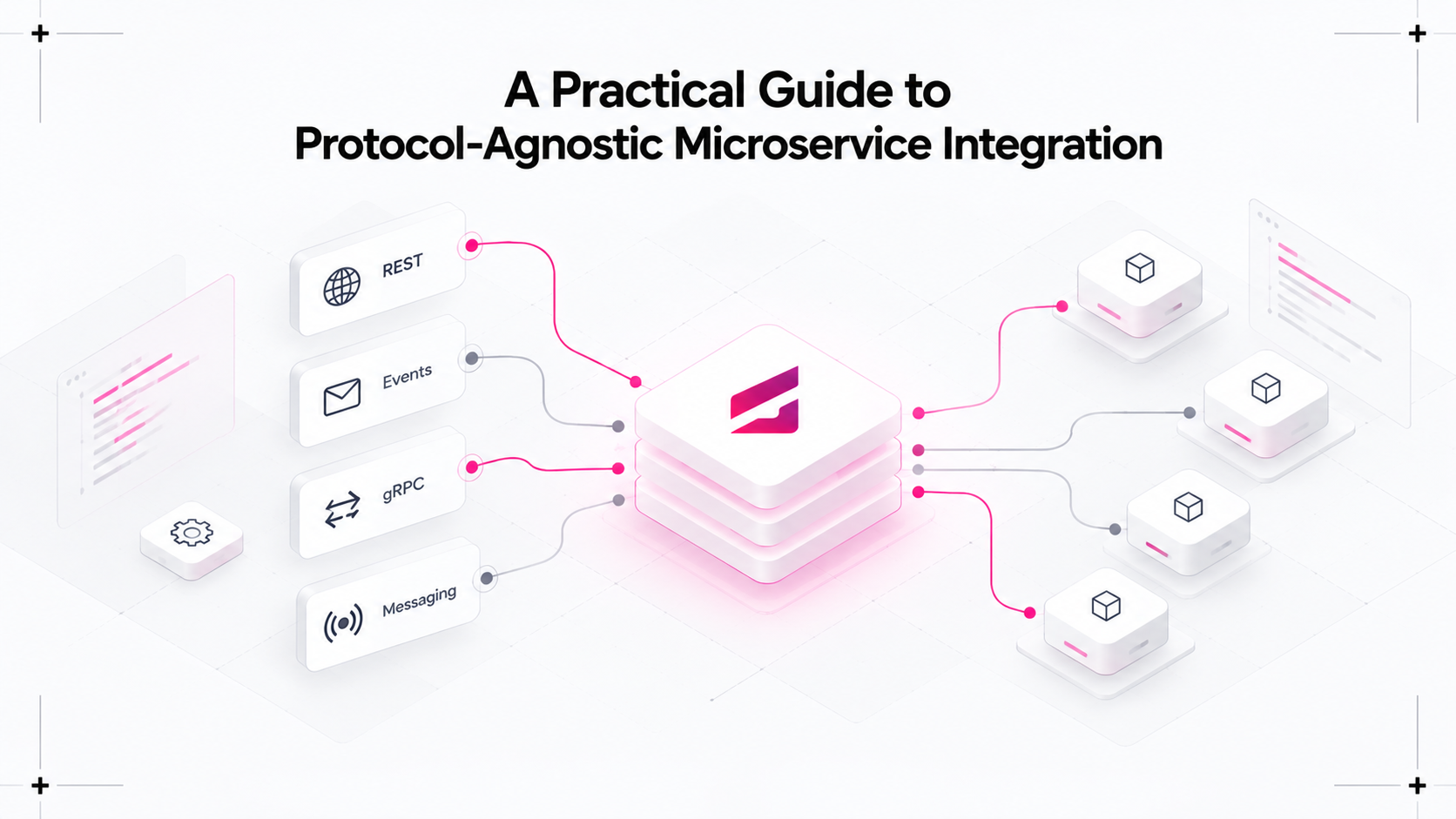
Underneath any integration between two services, three things are always happening, even when they're written as a single block of code. There's an interface: what one service is actually asking the other for: "check this inventory level," "process this payment," "confirm this order." There's a transport, the mechanism carrying that request across the network: HTTP, a message broker, a direct socket connection, gRPC. And there's a failure model: what happens when the call doesn't complete cleanly? Unlike a function call within a single process, a network call can time out, drop, or succeed with the wrong data.
Most systems end up using more than one integration pattern, and that's usually the correct outcome rather than a sign of inconsistency:
- Synchronous REST or RPC-style calls fit anywhere the caller needs an answer before it can proceed, in a user-facing request that must complete before a page renders, or in an internal call where the caller genuinely can't continue without a response.
- Asynchronous messaging or events fit workloads that don't need an immediate response and benefit from decoupling: a purchase triggering a notification, an inventory change triggering a re-order check, anything where the producer shouldn't have to wait on the consumer. This is also the one area where the industry has already built open standards for protocol-agnostic design: CloudEvents, maintained by the CNCF Serverless Working Group, defines a common event format with protocol bindings for HTTP, AMQP, and Kafka, so event metadata stays consistent no matter which broker carries it. AsyncAPI, a Linux Foundation project, does the same job that OpenAPI does for REST, but for event-driven APIs across brokers such as Kafka, AMQP, and MQTT.
- API gateway-mediated calls fit systems with external clients that need a single, stable entry point regardless of how the services behind it are organized.
- Service mesh is well-suited to large fleets of services that need consistent security, observability, and traffic management applied uniformly, without each service implementing that logic itself.
None of these patterns is a universal answer, and treating any one of them as the default for every call in a system is usually where integration problems start. The question isn't "which pattern should this system use"; it's "which pattern fits this specific call."
[3]Choosing the Right Integration Pattern for a Given Call
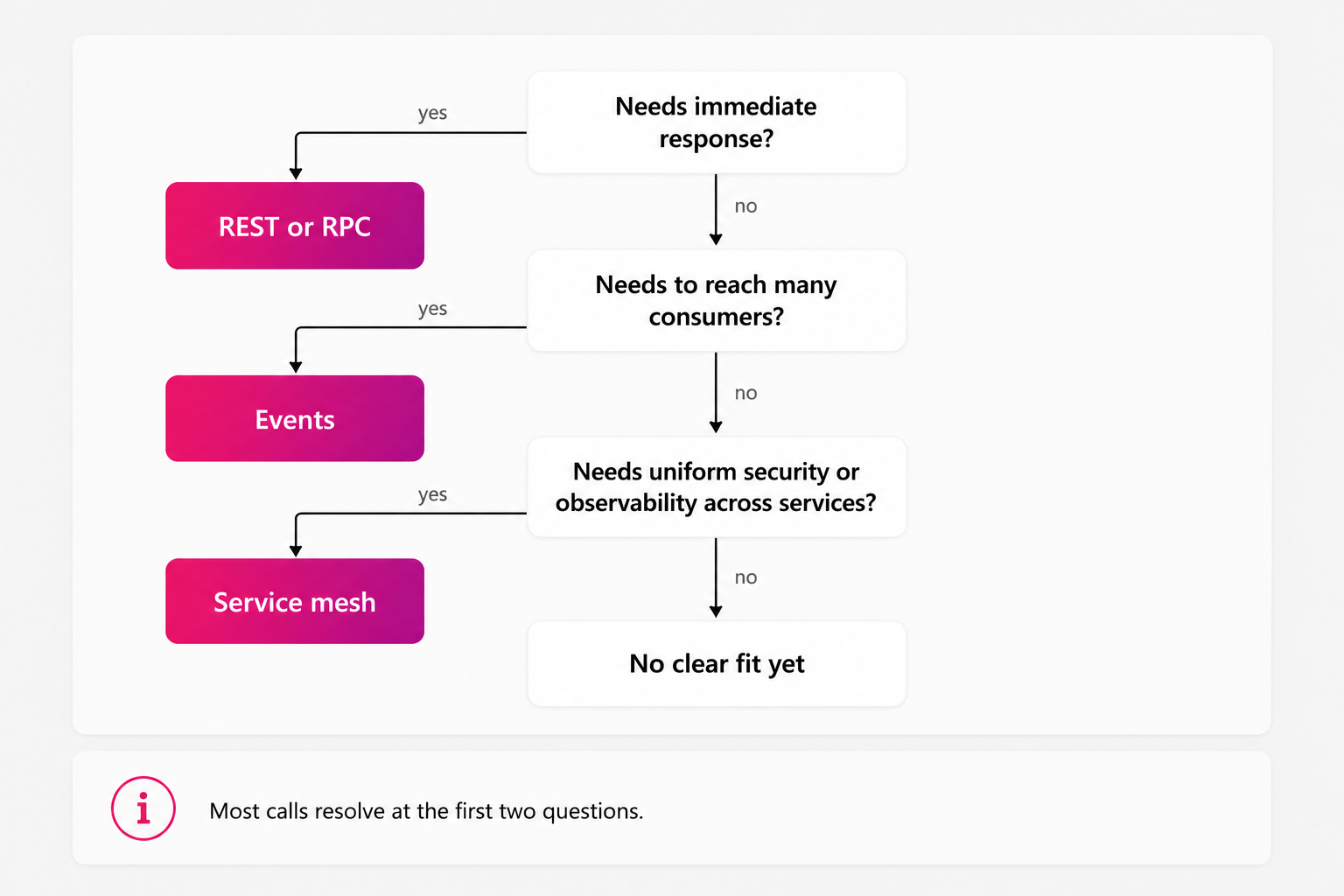
A short set of questions usually narrows the choice quickly:
- Does the caller need a response before it can continue? If yes, synchronous REST or RPC is the natural fit. If no, an async pattern removes an unnecessary blocking dependency.
- Does the workload need to reach many independent consumers from one event? Fan-out strongly signals an event-driven pattern over a point-to-point call.
- Is the call internal and latency-sensitive, or external and needing broad compatibility? Internal, latency-critical calls often favor a lighter-weight RPC-style approach; external-facing calls usually favor REST for its universal tooling support.
- Does this call need to survive temporary target-service unavailability? If so, a buffered approach, a queue or broker, absorbs that unavailability in a way a direct call can't.
- Is this one call among many that need consistent security and observability applied without duplicating that logic per service? That's the specific case a service mesh solves well; it's rarely worth the operational overhead for a handful of services.
None of these questions has a universally correct answer; they depend on the actual call being made, not the architecture pattern the system happens to follow elsewhere. A system that's "event-driven" overall can still have plenty of calls that are better served synchronously, and vice versa.
[4]Where Most Integration Approaches Quietly Fail
Regardless of which pattern you choose for a given call, the same failure mode tends to show up once the system has enough services: the interface and the transport get fused in the calling code, and changing one requires touching the other.
A REST client doesn't just express "get order status"; it expresses a specific HTTP method, a specific URL, specific headers, and a specific expected JSON shape. An event consumer doesn't just express "process this message"; it expresses a specific queue or topic name, a specific message schema, and specific deserialization logic. In both cases, the actual business intent is a small fraction of what's written, and the rest is transport-specific plumbing that has to be rewritten from scratch if the transport ever changes.
This is the root cause behind a pattern that shows up across nearly every microservices system as it scales: the integration surface grows disproportionately to the number of services. Three services fully interconnected need up to six integration paths to maintain; ten fully interconnected services can need up to ninety. The number of connections, not the number of services, is what drives the maintenance cost, and every one of those connections typically has its own hand-written client, its own DTOs, and its own place a schema mismatch can hide undetected.
None of this is specific to REST, or to any one pattern. It's a consequence of coupling the interface to the transport by default, which is the fastest way to ship a first version and also the reason changing an integration decision later is expensive. This exact problem, and specifically what it takes to make a transport decision reversible, is covered in depth in a companion piece on switching between REST, events, and messaging without rewriting calling code. This guide covers the same underlying mechanism at a higher level, as one part of the broader integration picture rather than the whole story.
[5]Making the Integration Choice Reversible
The fix isn't about picking a single "correct" pattern for the whole system; it's about separating what a service exposes from how a call reaches it, so that decision can change later without requiring a rewrite.
This isn't a new idea. Hexagonal Architecture, also called Ports and Adapters, introduced by Alistair Cockburn in 2005, describes exactly this separation: a service's core logic talks only to a "port," an abstract interface, while an "adapter" behind that port handles the actual mechanics of a specific transport, whether that's REST, a message broker, or a direct socket connection. The core logic never touches the adapter directly, so swapping REST for events, or one broker for another, means writing a new adapter rather than rewriting the logic that depends on it. Applied specifically to microservices, this is the same principle: a service's interface is the port; whatever HTTP client, event consumer, or RPC stub carries a given call is the adapter behind it.
This is the specific problem Graftcode addresses. A provider service runs behind a Graftcode Gateway, a runtime that hosts the service and, by default, automatically exposes its public methods without annotations or manual configuration. The provider team can narrow that exposure surface using type and method filters, but nothing has to be explicitly configured for a straightforward method to become callable.
./gg --projectKey <your-project-key> --modules ./order_service
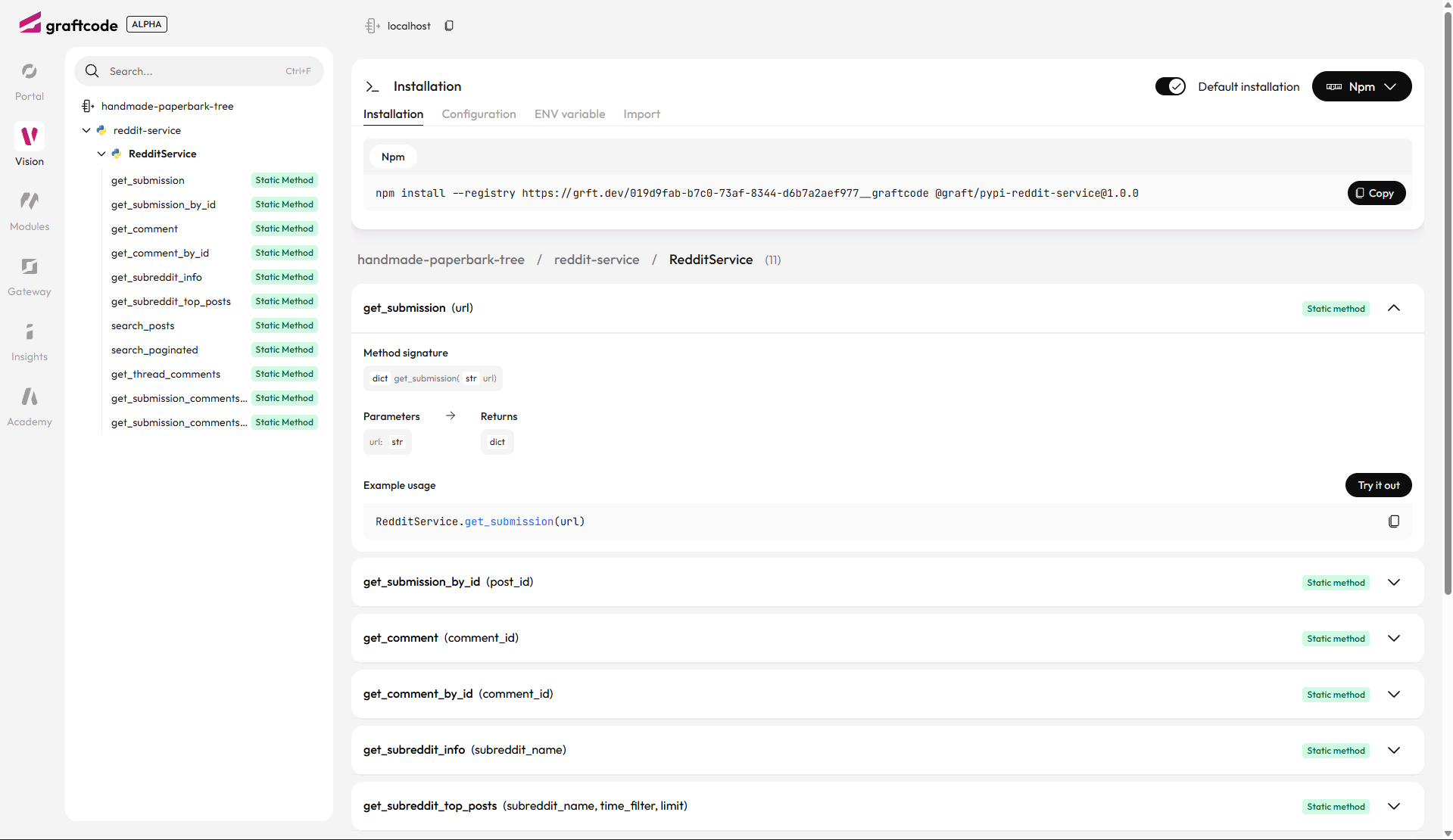
On the consuming side, instead of writing an HTTP client, an event consumer, or an RPC stub by hand, a service installs a Graft, a strongly typed interface generated directly from the provider's actual public methods, distributed through the language's standard package manager:
python -m pip install --extra-index-url https://grft.dev/simple/<project-id>__free graft-nuget-orderservice==1.0.0
The call itself reads as a plain method call, with none of the transport specifics baked in:
import osfrom graft_nuget_orderservice.graft.nuget.OrderService import GraftConfigfrom graft_nuget_orderservice.orderservice import OrderServiceGraftConfig.host = "wss://order-service:9000/ws"def get_order_status(order_id: str):return OrderService.get_status(order_id=order_id)
GraftConfig, an internal setting belonging to each individual Graft, is what determines how that call actually reaches the provider: in-process during local development, over a direct connection in production, or, where a broker fits the workload better, through Graftcode's official RabbitMQ transport plugin, which routes the call through a request/reply queue pair instead of a direct connection. Switching between these is a configuration change, not a rewrite of the calling code shown above.
This doesn't require replacing REST, an existing broker, or an existing service mesh. Graftcode sits above whatever transport a team is already using, reducing the hand-written integration work that would otherwise be layered on top. Graftcode's own published figures for this call layer are specific: calls made through a Graft run roughly 70% faster than equivalent web service calls, and consume roughly one-eighth the CPU of a comparable gRPC setup handling the same traffic, a measurable difference in execution cost, separate from the maintenance savings of not hand-writing the client. Every service exposed this way also becomes automatically reachable through the Model Context Protocol, which matters increasingly for teams whose AI coding tools need to reason about what a service actually does rather than inferring it from REST documentation.
[6]A Practical Checklist for Microservice Integration
Pulling this together, a handful of concrete things to check on a real system:
- Is the interface a service exposes documented in one place, and does that documentation stay current automatically, or does it drift out of sync with the code as the service changes?
- Does changing a call's transport require touching every caller, or is it a configuration change isolated to the calling service?
- Do integration failures get caught before they ship as a typed contract mismatch, or are they only discovered at runtime once real traffic hits the changed field?
- Is there any mechanism to verify that a service's interface hasn't silently broken a consumer, such as consumer-driven contract testing (Pact is the most widely used implementation), or does that only get discovered when a consumer's integration fails in production?
- Does the number of hand-written integration paths grow faster than the team maintaining them can keep up with, and if so, is that growth tracked anywhere, or only noticed once it's already a problem?
- Can a new service be integrated without duplicating the HTTP client and DTO pattern already used by three other services that call the same dependency?
A system that answers these well doesn't necessarily use any particular pattern; REST, events, RPC, and service mesh can all coexist reasonably well. What distinguishes a maintainable integration layer from one that quietly becomes a liability is whether these questions have deliberate answers, or whether the integration approach was never really decided, just accumulated one hand-written client at a time.
[7]Conclusion
Microservice integration isn't a single decision made once at the start of a system's life; it's a running set of choices, one per call, that either stay reversible or don't. REST, events, RPC, and service mesh each solve a real problem for the right kind of call, and using more than one pattern across a system is normal, not a design flaw. Systems consistently run into trouble when the same integration-layer problem shows up across every pattern: the interface and transport fused together in the calling code, growing faster than the team maintaining it, and expensive to change once a decision proves wrong.
Separating a service's interface from its transport, so the integration pattern for a given call is a configuration decision rather than an architectural commitment, is what keeps that growth manageable. Whether that separation comes from disciplined API design, a service mesh, or a tool like Graftcode built specifically around this boundary, the underlying goal is the same: make the connections between services something the system can change its mind about, without every caller needing to change with it.
To see how Graftcode handles this boundary directly, explore Graftcode or go straight to the Graftcode Academy to get started.
[8]FAQs
1. What's the difference between microservice integration and protocol-agnostic design?
Microservice integration is the broader problem of how services communicate, which pattern to use for a given call, whether synchronous, async, or gateway-mediated. Protocol-agnostic design is a specific technique within that problem: separating a service's interface from its transport so the transport can change without changing the calling code. It solves part of the integration problem, not the whole thing; pattern selection and failure handling still matter regardless of whether the transport itself is swappable.
2. Should a microservices system standardize on a single integration pattern?
Usually not. Different calls have different requirements; some need an immediate response, others benefit from async decoupling, and a few need the uniform security and observability a service mesh provides. Forcing every call through a single pattern typically means some calls use the wrong tool for their actual requirements, even if the system looks architecturally consistent on paper.
3. Why does integration overhead grow faster than the number of services in a system?
Because the cost scales with the number of connections between services, not the number of services themselves, and those connections grow combinatorially. Three fully interconnected services need up to six integration paths; ten need up to ninety. A system can add services steadily, while the number of handwritten integration paths beneath it grows much faster.
4. How does Graftcode support multiple integration patterns without locking a team into one?
GraftConfig, set per Graft, determines whether a call runs in-process, over a direct connection, or through a broker-mediated plugin such as Graftcode's official RabbitMQ transport. The calling code stays identical across all three, so a team can change how a specific call reaches its target, including moving it onto or off of a message broker, as a configuration change rather than a rewrite.
5. Does adopting a tool like Graftcode mean replacing an existing API gateway or service mesh?
No. Graftcode sits above whatever transport and infrastructure a team already has, REST, gRPC, a broker, a gateway, or a mesh, and reduces the hand-written integration code layered on top of it. It's designed to be adopted incrementally for the specific service pairs causing the most integration overhead, not as a wholesale replacement for existing infrastructure.
/WRITTEN BY