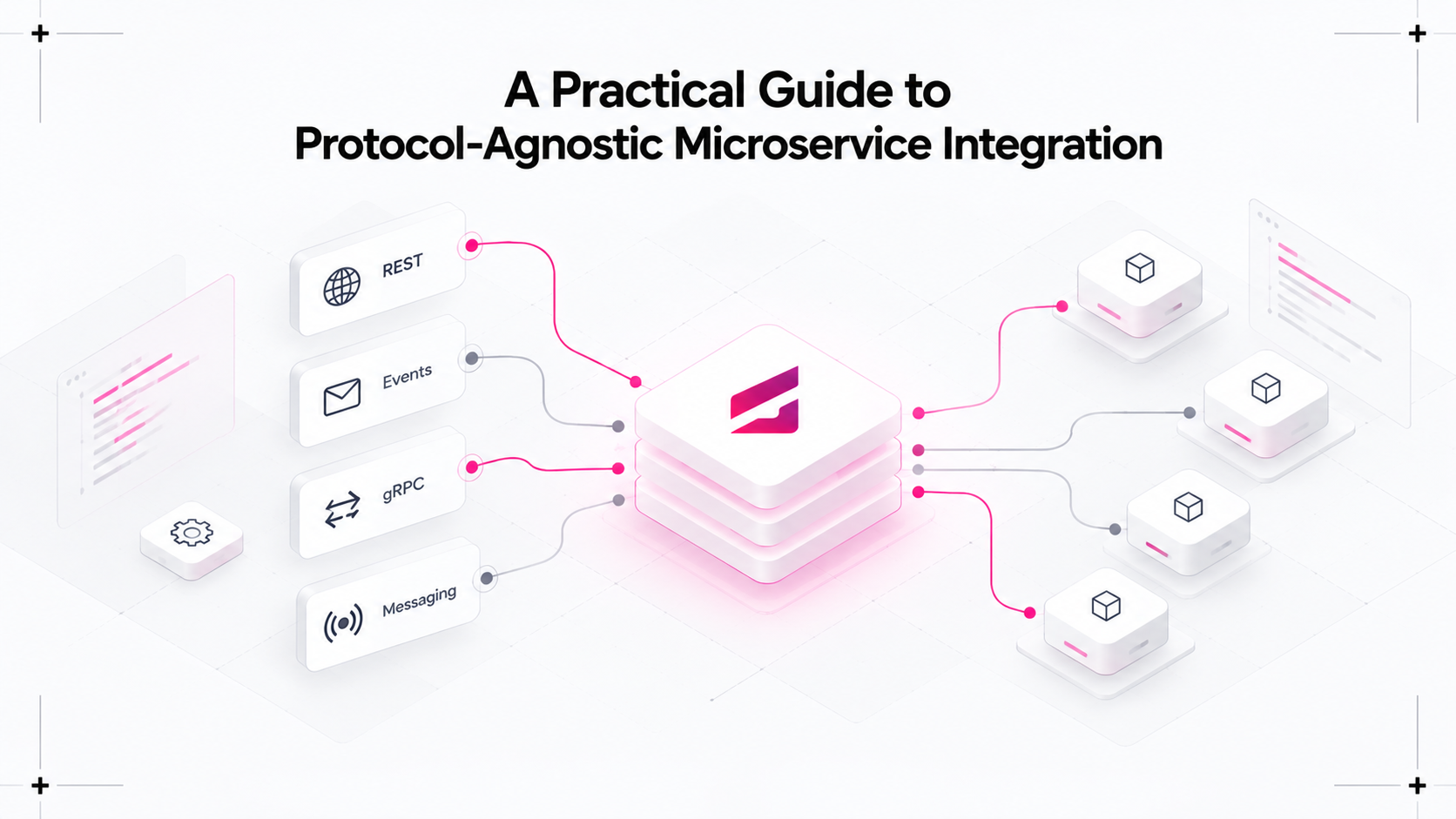
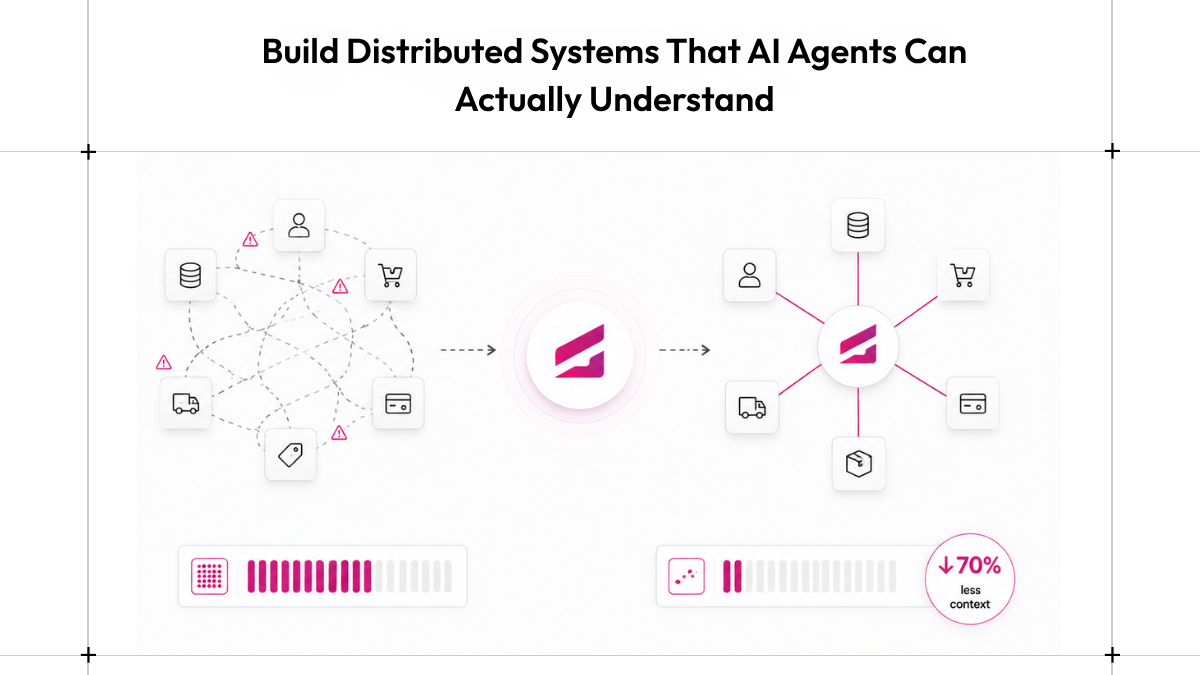
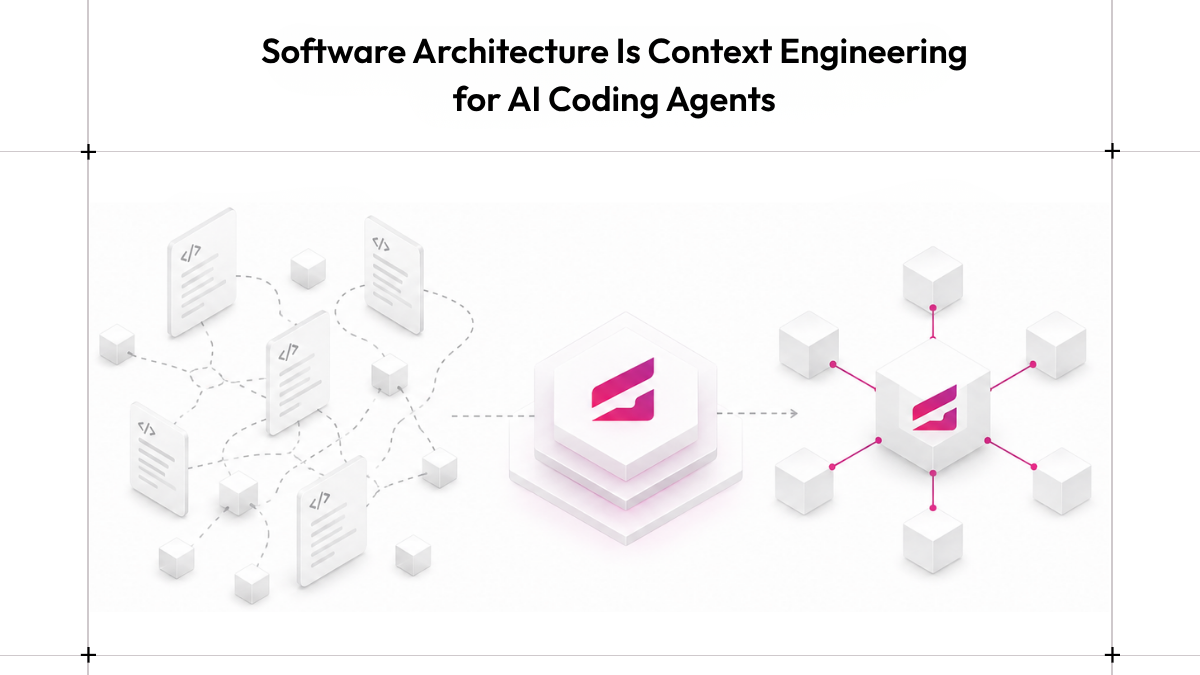
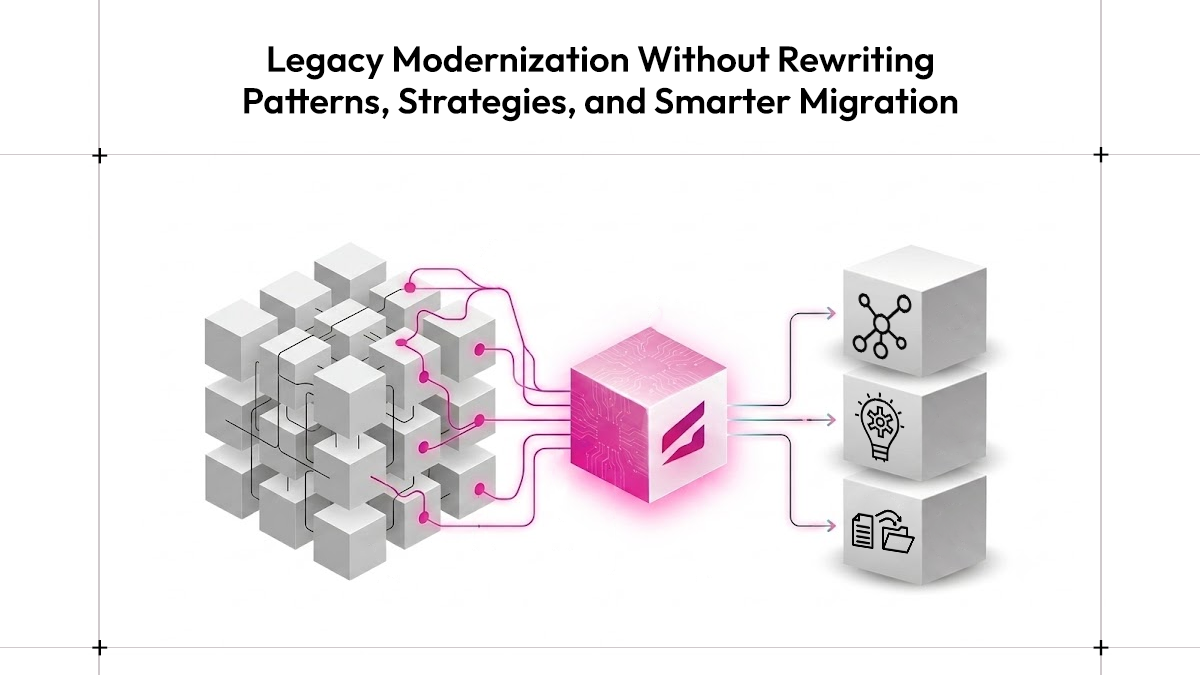
Legacy Modernization Without Rewriting: Patterns, Strategies, and Smarter Migration
/TABLE OF CONTENTS
/ARTICLE
/ARTICLE
[1]TL;DR
- Modernization projects rarely stall because a team picked the wrong pattern. They stall because teams underestimate the integration cost each pattern carries, the work of bridging what's been extracted back to what remains.
- Branch by Abstraction, Parallel Run, and Anti-Corruption Layer each solve a different problem. Picking the right one for the situation matters more than picking a "best" one.
- A good first extraction candidate has no shared database tables, synchronous-only callers, externally managed state, a narrow interface, and existing test coverage; most modernization failures trace back to skipping this checklist.
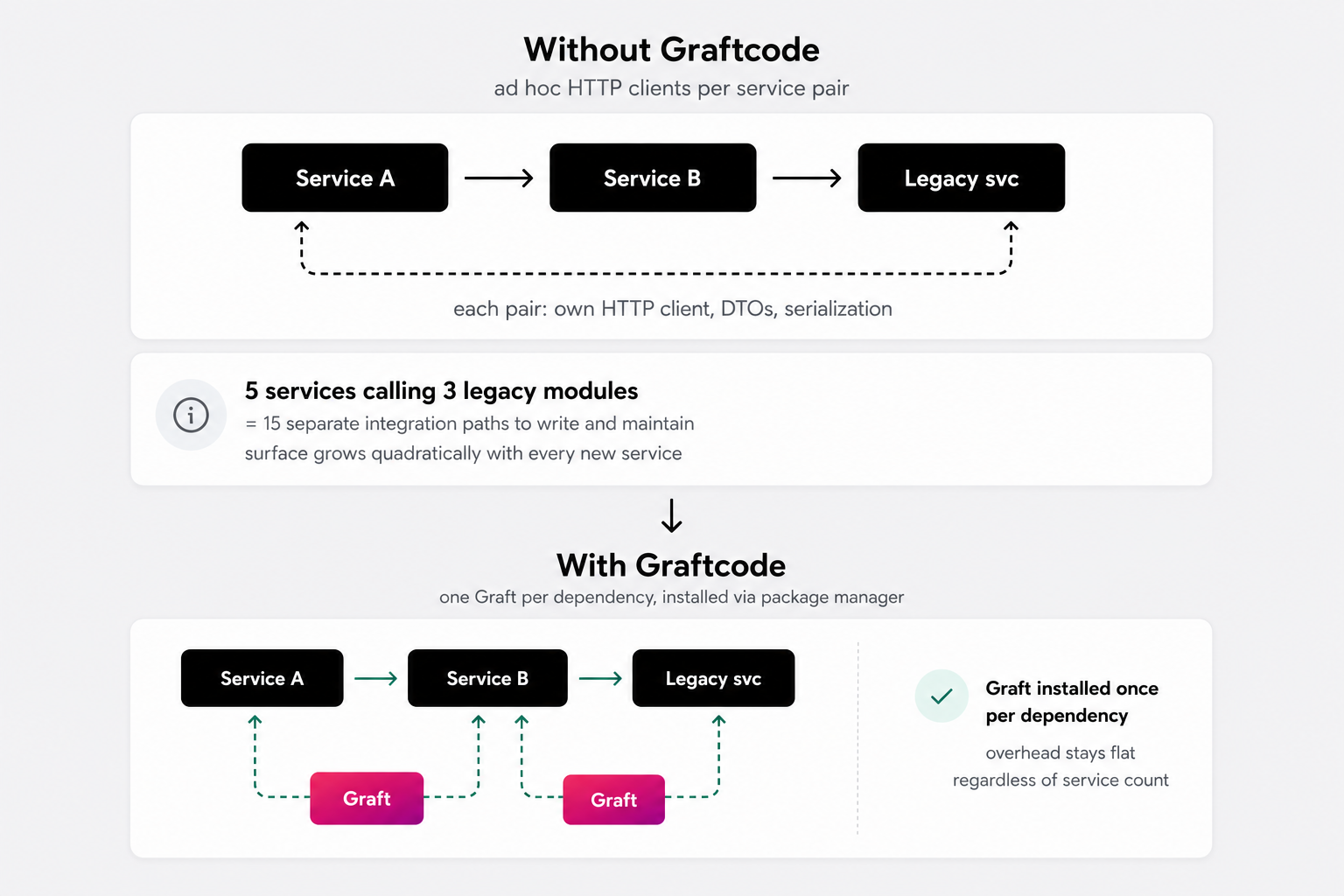
- Graftcode doesn't change which pattern is right for a given situation. It changes the cost of executing whichever pattern you pick by replacing the HTTP clients, DTOs, and manual versioning each pattern otherwise requires with a strongly typed Graft installed via a package manager.
If you're still deciding whether to modernize incrementally at all, or want the safety-focused case for why rewrites tend to fail, start with Legacy Modernization Without Rewriting: How to Extend Existing Systems Safely.
Most legacy systems don't fail suddenly. They accumulate friction, longer release cycles, fragile cross-module dependencies, and rising operational risk until a simple change takes three times as long as it should. At that point, a full rewrite starts to look appealing, and teams that have already decided against that path still have real decisions ahead of them: which pattern to use, where to start, and what mistakes will quietly derail progress even when the pattern itself is sound.
This guide assumes you've already ruled out the rewrite. It's about the decisions that come next, which pattern fits which situation, how to pick a first extraction that won't stall, the mistakes that repeat across teams that already understand the patterns, and where Graftcode changes the cost calculation enough to make a pattern worth choosing.
[2]What Is Legacy Modernization
Legacy modernization is the process of updating or replacing software systems that have become difficult to change, scale, or maintain, without losing the business logic and institutional knowledge embedded in them.
Most legacy systems weren't built badly. They were built for the constraints of their time: a different scale, a different team size, a different deployment model. The problem isn't the original decisions; it's what compounds on top of them over years. New features get bolted on, abstractions leak, and the codebase becomes harder to reason about with every change.
Legacy modernization covers a spectrum of approaches:
- Replatforming: moving the existing system to new infrastructure (cloud, containers) without changing the code. Lowest risk, lowest reward.
- Refactoring: restructuring internal code without changing external behavior. Improves maintainability but doesn't address architectural constraints.
- Re-architecting: changing the system's structure, typically from monolith to services, while preserving core business logic. Higher risk, higher reward.
- Replacing: rewriting from scratch. Highest risk, justified only when the existing system is fundamentally unsalvageable.
Most teams attempting modernization sit somewhere between re-architecting and replacing, and the patterns in this guide address that space specifically: moving toward a more flexible, independently deployable architecture while keeping the system live and delivering value throughout.
[3]Why Legacy Systems Are Harder to Modernize Than They Look
Legacy systems are hard to modernize not because the code is bad, but because the coupling is invisible until you try to move something. Every module that looks self-contained turns out to have tendrils reaching into shared databases, shared utility libraries, and implicit runtime contracts that were never documented.
Three failure patterns repeat across modernization projects regardless of team size or stack, each with a distinct root cause:
Big-bang rewrites. The team estimates 12 months, delivers in 24, and ships a system that doesn't match what users actually need because requirements shifted during the rewrite. A Rails monolith being rewritten in Go is a common example; by the time the Go version ships, the original Rails app has received 40 new feature commits the new system doesn't account for. The legacy system accumulated two more years of patches while the rewrite was in progress.
Partial migrations that freeze. A team extracts auth and product catalog cleanly, then hits order management, a module that writes directly to 11 tables shared with inventory, billing, and fulfillment. No clean extraction path exists without touching all four services simultaneously. The migration stalls, and the organization ends up running two systems indefinitely, with the complexity of both and the benefits of neither.
Integration cost exceeding extraction value. A Python data service extracted from a Java monolith is clean on its own. The problem is bridging it back to the monolith requires a Java HTTP client, a DTO mapping layer, a versioning strategy, and error handling for network failures the original in-process call never had. The extracted service took two weeks to build. The bridge took three. Multiply that across five more extractions in three languages, and the integration overhead consumes every hour the extraction was supposed to save.
The third failure mode is the most common and the least discussed. The pattern is fine. The integration layer is where teams lose momentum.
[4]The Strangler Fig Pattern: Incremental Extraction Without Stopping the System
The Strangler Fig pattern is the foundational approach to incremental modernization. Named after a vine that grows around a host tree and gradually replaces it, the pattern lets you extract functionality from a legacy system piece by piece while keeping the system live throughout.
The core mechanism is a routing layer, an API gateway, a reverse proxy, or an application facade, placed in front of the legacy system. This routing layer is separate from the Graftcode Gateway discussed later in this piece. The Strangler Fig routing layer sits in front of the legacy system and directs traffic to it; the Graftcode Gateway is not a proxy or traffic router at all; it's the runtime that hosts a service and exposes its methods to callers. As new services are introduced, the routing layer progressively shifts traffic from legacy to new services. To users and downstream systems, it appears to be one system; internally, it's a controlled handover.
In three phases: deploy a routing layer that initially passes everything through unchanged, then identify and extract bounded contexts one at a time as independent services with traffic shifted for each, and finally retire the legacy system once it's handling progressively less until it becomes a thin shell.
For a deeper walkthrough of why this pattern is the safer alternative to a big-bang rewrite, including the Knight Capital case study on what goes wrong when old and new systems coexist without a properly managed boundary, see How to Extend Existing Systems Safely.
The mechanic itself is well understood. What separates teams that keep momentum from teams that stall is the decisions around it: which module to extract first, and which supporting pattern to reach for when Strangler Fig alone isn't enough.
[5]What Makes a Good First Extraction Candidate
The first extraction sets the tone for every one that follows. Pick a hard first candidate and the team learns that extraction is expensive and slow. Pick a good one and the team builds the muscle memory and tooling that make the next four extractions faster.
A good first candidate has all five of these properties:
No shared database tables. If a module reads and writes tables that other modules also touch, extraction requires resolving data ownership first; that's a separate project. Start with modules that cleanly own their data.
Synchronous-only callers. Modules that are only called synchronously and return a direct response are simpler to route behind a facade. Async event producers or consumers add broker configuration to the extraction scope.
Stateless or externally managed state. A module that holds no in-process state, or stores state in Redis or a dedicated database, can be extracted and scaled independently without session affinity concerns.
Narrow interface. A module with three or four public methods can be extracted in a few days. A module with 40 endpoints called from across the codebase requires interface auditing before anything moves.
Existing test coverage. Without tests, the parallel-run pattern, running the legacy and extracted versions simultaneously and comparing outputs, has no baseline to validate against. Extraction without coverage is extraction without a safety net.
| Approach | Risk | Value delivery | System availability |
|---|---|---|---|
| Big-bang rewrite | Very high | Delayed until completion | Degraded during rewrite |
| Strangler Fig | Low, incremental | Continuous | Live throughout |
| Partial rewrite | Medium | Mixed | Dependent on scope |
Strangler Fig handles the extraction mechanism. It doesn't automatically solve the integration problem: the work of making the extracted service and the legacy system communicate cleanly. That's where the choice of supporting pattern matters.
[6]Three Patterns, Three Different Problems
Strangler Fig doesn't work alone in complex migrations. Three supporting patterns each solve a different problem that arises during extraction; the decision isn't which one is "best," it's which problem you actually have.
Use Branch by Abstraction when a module has many internal callers
Branch by Abstraction introduces an interface layer inside the monolith before extraction begins. Callers within the monolith talk to an interface, not a concrete implementation. The concrete implementation can then be swapped from the legacy code to the extracted service without touching any callers.
This matters most when a module is called from dozens of places within the monolith; updating every call site individually would be disruptive in its own right, independent of the extraction itself.
Graftcode fits naturally here without replacing the pattern itself. Branch by Abstraction is still the developer's own interface; call sites stay stable while the underlying implementation is swapped out from under them. What changes is what sits behind that interface: instead of a hand-written client calling the legacy code directly, the interface's implementation can be a Graft, a generated client that points to either a local or remote target. Switching that target from in-memory to remote, the actual monolith-to-microservice cutover, is a GRAFT\_CONFIG change, not a code change, and it's independent of the abstraction layer itself. The interface you introduced for Branch by Abstraction is what keeps callers stable; GraftConfig is what controls where the calls actually go once they're behind it.
Use Parallel Run when behavioral correctness has to be validated under real traffic
Parallel Run sends requests to both the legacy system and the new service simultaneously and compares outputs before committing to the new path. Discrepancies are logged but don't affect users; the legacy response is always returned until the new service is validated.
Here's what that looks like in a Java order service:
// Shadow-compare new service against legacy without affecting userspublic OrderResponse handleOrder(OrderRequest request) {OrderResponse legacy = legacyClient.getOrder(request);// Fire-and-forget comparison, never blocks the user responseCompletableFuture.runAsync(() -> {try {OrderResponse modern = newServiceClient.getOrder(request);if (!modern.equals(legacy)) {metrics.increment("strangler.mismatch");log.warn("Divergence for {}: legacy={} modern={}",request.id(), legacy, modern);}} catch (Exception e) {metrics.increment("strangler.new_path_error");}}, comparisonExecutor);return legacy; // user always gets the trusted answer}
The key detail is CompletableFuture.runAsync; the comparison never blocks the response path. If the new service is slow or throws an exception, the user never sees it. The mismatch counter indicates whether the extracted service is ready to take over.
This pattern is right when a silent regression costs real money: payment processing, order fulfillment, anything where correctness matters more than speed of rollout. Its usual downside is the extra integration cost of building newServiceClient just for validation, a second HTTP client and DTO layer that exists purely to compare outputs, not to serve production traffic. With Graftcode, that client is a Graft instead: strongly typed, compile-time safe, and if the new service changes its response shape mid-validation, that change is visible as a package update the team can review, surfacing as a compile-time failure in the harness if applied, rather than a silent divergence buried in the logs. That changes the calculation on whether Parallel Run is worth the setup cost for a given extraction.
Use Anti-Corruption Layer when the legacy domain model shouldn't leak into the new service
The Anti-Corruption Layer (ACL) is a translation layer that sits between the legacy system and the new service, translating legacy domain concepts into the new service's domain model. Without it, the new service inherits the legacy system's field names, data shapes, and quirks, and effectively becomes a second legacy system in a new codebase.
This matters when the legacy domain model is fundamentally different from the target model: different field semantics, different status representations, different ways of modeling the same real-world concept.
An ACL doesn't have to be a separate deployment; it's often implemented as an adapter living inside the new service itself, or at the edge of the monolith, translating as calls pass through. One deployment option is standing it up as its own translation service between the monolith and the extracted service. When it is deployed that way, it typically becomes a cross-language boundary of its own: the monolith calls the ACL, and the ACL calls the new service, two integration hops instead of one, which is usually what makes teams skip building it under timeline pressure. Graftcode handles both of those hops in that scenario: the monolith installs a Graft for the ACL, and the ACL installs a Graft for the new service. No HTTP client on either side of the translation layer, which removes the doubled integration cost that normally makes a standalone ACL feel too expensive to justify.
[7]Common Mistakes That Compound the Integration Cost
Teams that understand the patterns still hit these repeatedly.
Shared database between monolith and extracted service. Stems from extracting service logic without extracting data ownership; teams move the code first and defer the data migration to reduce risk, but "later" rarely arrives, and the shared table becomes permanent coupling. If the extracted service reads and writes the same tables as the monolith, a network hop has been added without achieving isolation. Use dual-write or Change Data Capture during the transition, then cut over once the new service's data is validated.
Migrating too many modules simultaneously. Stems from org pressure to show progress across multiple teams at once; each team picks a module and starts extracting in parallel, and the integration surface multiplies faster than any one team can track. Every active extraction is a partially bridged system that requires maintenance; running five in parallel means five sets of DTOs to keep in sync and five integration surfaces that can drift independently. Extract sequentially, completing each one before starting the next.
Treating migration bridges as temporary when they're not. Stems from the gap between the team that built the bridge and the team that inherits it. The original team knows it's temporary; six months later, a different team owns it, the "temporary" label is gone from the commit message, and it's carrying production traffic with no tests. Graftcode's strongly typed interfaces, which surface incompatibilities as reviewable package updates and fail at compile time when applied, force the contract to be treated seriously from the start; there's no such thing as a "quick HTTP client" when the interface is enforced.
No observability across the boundary. Stems from instrumenting the new service without instrumenting the boundary itself. Teams add logging inside the extracted service but forget the call that crosses the monolith-to-service seam, the place where most failures first surface. Distributed tracing across the boundary is non-negotiable; without it, debugging a failure that crosses the extraction boundary means guessing which side owns the problem.
Skipping the Anti-Corruption Layer when domain models diverge. Stems from timeline pressure; the ACL adds work before extraction begins, teams skip it intending to add it later, and discover the legacy domain model has already leaked into the new service's data structures. Once legacy concepts are embedded in the new service, it inherits the old constraints, and the extraction provides no architectural benefit. If the domain models genuinely differ, design the ACL before any code moves.
[8]When the Strangler Fig Pattern Is Not the Right Choice
Incremental extraction isn't universally applicable. The pattern fails or becomes counterproductive in specific situations:
- Tightly coupled UIs. Server-side-rendered monoliths where the frontend and backend are inseparable are significantly harder to extract with a Strangler Fig approach. Consider a micro-frontend decomposition layer first.
- Batch-first systems. Systems primarily built around nightly batch processing rather than request/response flows don't benefit from facade-based routing; the pattern assumes real-time traffic that can be progressively redirected.
- Broken domain models. If the legacy system's domain model is fundamentally wrong, not just poorly implemented but conceptually incorrect, incremental extraction perpetuates the bad model. Design the target model first before any extraction begins.
- Small, isolated systems. For systems small enough that a careful rewrite takes weeks, the overhead of introducing a facade and incremental routing outweighs the risk reduction. Evaluate honestly whether the system actually needs incremental extraction or just a focused rewrite.
A Concrete Cross-Language Extraction
Consider a Python ML inference service being extracted from a Java monolith. Without a typed communication layer, the Java side needs a hand-written HTTP client, DTO definitions matching the Python service's schema exactly, and error handling that the original in-process call never needed:
// Java monolith calling extracted Python inference service, without Graftcodepublic class InferenceClient {private final HttpClient httpClient = HttpClient.newHttpClient();private final ObjectMapper mapper = new ObjectMapper();public InferenceResult callInferenceService(String modelId, float[] inputVector) {try {Map<String, Object> payload = Map.of("model_id", modelId,"input_vector", inputVector);HttpRequest request = HttpRequest.newBuilder().uri(URI.create("http://inference-service:8080/api/v1/infer")).header("Content-Type", "application/json").POST(HttpRequest.BodyPublishers.ofString(mapper.writeValueAsString(payload))).build();HttpResponse<String> response = httpClient.send(request, HttpResponse.BodyHandlers.ofString());return mapper.readValue(response.body(), InferenceResult.class);} catch (Exception e) {throw new RuntimeException("Inference service call failed", e);}}}
If the Python team renames input\_vector to inputs, this Java code doesn't fail at compile time. Since input\_vector is a field the Java side sends, the failure most likely shows up as a validation error or an unrecognized field on the Python service's side, not a null on the Java side; either way, there's no signal until it happens under real traffic.
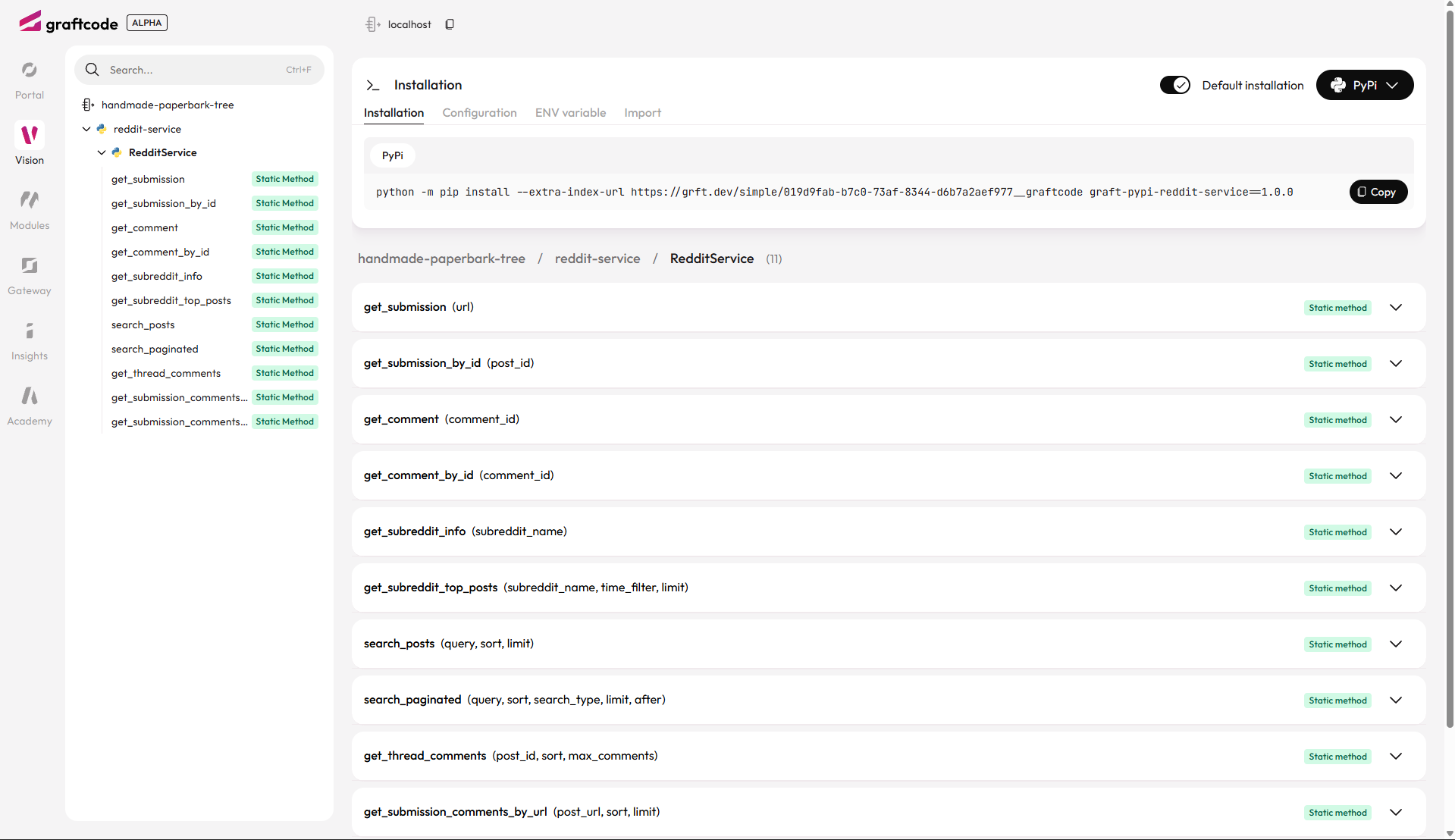
To install a Graft for this service instead, Graftcode Vision, running at the inference service's Gateway, generates the exact repository URL and Maven dependency coordinates. The Java monolith adds them to its pom.xml:
<?xml version="1.0" encoding="UTF-8"?><project xmlns="http://maven.apache.org/POM/4.0.0"xmlns:xsi="http://www.w3.org/2001/XMLSchema-instance"xsi:schemaLocation="http://maven.apache.org/POM/4.0.0http://maven.apache.org/xsd/maven-4.0.0.xsd"><modelVersion>4.0.0</modelVersion><groupId>com.example</groupId><artifactId>order-platform</artifactId><version>1.0.0</version><repositories><repository><id>graft-repository</id><url>https://grft.dev/maven2/your-project-id__free</url></repository></repositories><dependencies><dependency><groupId>graft.maven.com.example</groupId><artifactId>inference-service</artifactId><version>1.0.0</version></dependency></dependencies></project>
Note that the repository URL and dependency coordinates shown here are illustrative; the exact group ID, artifact ID, and repository URL are generated by Graftcode Vision for the specific service being called, and should be copied from there rather than typed by hand.
Update the calling code to use the Graft instead of the hand-written HTTP client:
package orders;import com.graft.maven.inferenceservice.GraftConfig;import com.graft.maven.inferenceservice.InferenceService;public class InferenceCaller {static {GraftConfig.setConfig(System.getenv("GRAFT_CONFIG"));}public InferenceResult runInference(String modelId, float[] inputVector) throws Exception {// Strongly typed: if Python renames a field, this fails at compile timereturn InferenceService.infer(modelId, inputVector);}}
GraftConfig reads its configuration from a single GRAFT\_CONFIG environment variable at startup, a structured string specifying the Graft's name, the target host, the runtime, and the module path:
# Local development: in-process, no network callGRAFT_CONFIG="name=com.graft.maven.inferenceservice;host=inMemory;runtime=jvm;modules=/usr/app/target"# Production: points to the deployed inference service's GatewayGRAFT_CONFIG="name=com.graft.maven.inferenceservice;host=inference-service:9092;runtime=jvm;modules=/usr/app/target"
The calling code in InferenceCaller never changes between these two states; only the GRAFT\_CONFIG value does. This is the same mechanism the "before" example lacked entirely: no HTTP client, no DTO class, no JSON parsing. If the Python inference service renames a method or changes a return type, the incompatibility is visible as a package update the Java team can review, and surfaces at compile time in the Java codebase if they apply it, well before it reaches production.
[9]Conclusion: Modernization Without Rewriting
Legacy modernization doesn't fail because teams pick the wrong pattern. Strangler Fig, Branch by Abstraction, and Parallel Run are well-understood and genuinely effective. Modernization fails because the integration work between what's been extracted and what remains compounds, and because teams choose a supporting pattern without weighing the actual execution cost for their specific situation.
The patterns tell you how to extract. Knowing which one fits your actual problem, choosing a first extraction candidate that won't stall, and avoiding the mistakes that compound integration costs are what make incremental extraction sustainable across ten extractions, not just two.
Graftcode changes the cost side of that equation for each pattern specifically: a Graft in place of the shadow client in a Parallel Run, a Graft as the interface in a Branch by Abstraction, Grafts on both hops of an Anti-Corruption Layer, making patterns that would otherwise feel too expensive to justify practical to actually use.
To see how Graftcode fits your specific pattern choice, explore Graftcode or go straight to the Graftcode Academy to get started.
[10]FAQs
1. What is the difference between the Strangler Fig pattern and a big-bang rewrite?
A big-bang rewrite replaces the entire legacy system in a single effort, with no incremental value delivery and high risk, typically measured in years. The Strangler Fig pattern extracts functionality piece by piece while the legacy system stays live, with each extraction independently deployable and reversible. The business keeps running throughout, and teams deliver value continuously rather than betting everything on a single cutover.
2. How do you choose between Branch by Abstraction, Parallel Run, and Anti-Corruption Layer for a given extraction?
The choice depends on which specific problem the extraction has. Use Branch by Abstraction when a module has many internal callers and updating each one individually would be disruptive. Use Parallel Run when behavioral correctness under real traffic is critical and a silent regression would be costly. Use Anti-Corruption Layer when the legacy domain model is fundamentally different from the target model and shouldn't be allowed to leak into the new service. These aren't mutually exclusive; a single extraction can use more than one.
3. What makes a module a good candidate for the first extraction in a migration?
Five properties matter most: no shared database tables with other modules, synchronous-only callers, stateless or externally managed state, a narrow interface (a handful of methods rather than dozens), and existing test coverage for validation. A first extraction missing several of these properties is likely to stall and set the wrong expectations for the extractions that follow.
4. How does Graftcode change the cost of using Parallel Run or Anti-Corruption Layer specifically?
Both patterns carry integration overhead beyond the extraction itself. Parallel Run requires a shadow client purely for output comparison; Anti-Corruption Layer requires a translation service with integration hops on both sides. Graftcode replaces the hand-written HTTP clients in both cases with installed Grafts, strongly typed, compile-time safe, with no serialization code, which lowers the setup cost enough to make these patterns worth choosing rather than skipping under timeline pressure.
5. What's the most common mistake teams make even after they understand the modernization patterns?
Treating the integration bridge between legacy and extracted services as temporary. The team that builds it knows it's meant to be replaced; the team that inherits it six months later often doesn't, and it ends up carrying production traffic with no test coverage. Enforcing typed contracts at the boundary from the start, rather than relying on a quick handwritten HTTP client, prevents this mistake from compounding.
/WRITTEN BY